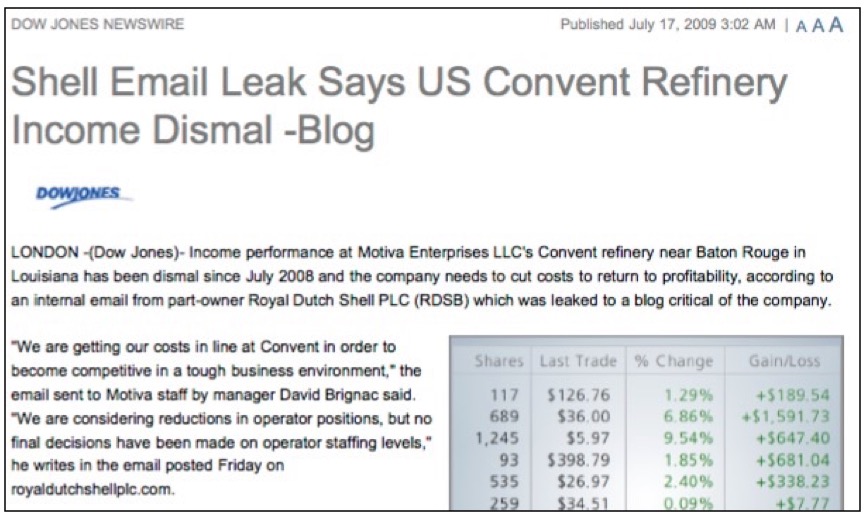
We receive insider information about Shell from a variety of sources. From disgruntled Shell employees; from Shell itself in response to Subject Access Requests; from information, Shell has sent to us by accident and from searching and retrieving documents from court files. We have, for example, published a leaked internal email from an incoming Chief Executive Officer of Royal Dutch Shell Plc on the same day he sent it, resulting in another huge embarrassment for Shell.
As indicated above, we receive insider information about Shell from a number of different sources.
The first is from Shell itself.
Shell has supplied Shell internal documents and internal emails directly to me in compliance with a series of SAR applications.
The internal documents revealed that Shell secretly set up a counter-measures team and mounted a global spying operation in a determined, but unsuccessful bid to stop the flow of Shell insider information to me.
Another source is from disgruntled Shell employees who have supplied insider information and Shell internal documents and internal emails.
The leaks have been very damaging to Shell, generating many news articles around the world, including a front page story in the Financial Times.

On occasion, we have published internal emails from the most senior executive directors of Royal Dutch Shell Plc on the day they were sent e.g. this email from the then incoming Chief Executive Officer, Mr Peter Voser.
We have also received Shell email sent to us in error. In June 2004, Richard Wiseman accidentally sent us a copy of an email about my father that he had intended to send only to the then Chief Executive Officer of Royal Dutch Shell Plc, Jeroen van der Veer, and the then No. 2 at Shell, Mr Malcolm Brinded. Consequently, we knew that the top executive directors had been kept personally informed about our activities. It was also apparent from the email that Shell “PX” kept a standard response about us ready to use as needed. An item we have never seen despite numerous SAR applications.
I receive information from an American Pacer account that provides me with access to the USA courts electronic filing system. I search Pacer from time to time for litigation relating to Shell and make the documents freely available on my website. I have published many thousands of pages from legal documents, witness statements etc that would otherwise be hidden behind a paywall.
Prominent retired Royal Dutch Shell Group senior staff have contributed highly informative comments/articles published on the royaldutchshellplc.com website. They include former global executive Paddy Briggs; retired HSE Group Auditor, Bill Campbell, and retired Global Chief Petroleum Engineer, Iain Percival. This input provides an additional source of “insider” expert information.
I have provided examples in this chapters screenshot gallery of articles published by the world’s leading financial news media resulting from Shell insider information leaked to me.


A further notable leak occurred in September 2021: Shell considers mandatory covid vaccination and firing staff who refuse
Shell considers mandatory covid vaccination and firing staff who refuse
Shell considers mandatory covid vaccination and firing staff who refuse
“For staff who refuse to comply with a vaccine mandate we would make all reasonable efforts to avoid terminating their employment but will be faced with no alternative but to do so.”
RELATED FT, REUTERS, TELEGRAPH AND WALL STREET JOURNAL ARTICLES BELOW ALL MENTION THE LEAKED INFORMATION THAT JOHN DONOVAN SUPPLIED TO EACH OF THEM
By John Donovan
I am in possession of Shell international comms including a 6 page “Note for discussion” sponsored by Shell Executive Committee member Ronan Cassidy, Chief HR and Corporate Officer at Royal Dutch Shell.
Extracts from the 6 page Note for discussion dated 1 September 2021
The paper examines the case for and against company-mandated vaccination for employees/contractors. Vaccination is one of the most critical barriers to mitigate the impact of Covid. But mandating it for staff and contractors risks violating the ‘respect for people’ principle and inviting some unanticipated consequences.
The paper provides business leaders and Country Chairs with a framework for considering such situations and proposes a mechanism for seeking Group support on an exception basis.
Shell is obliged to provide a safe and healthy workplace for all its employees. This means managing and mitigating the risk from Covid 19, as it is impossible to prevent, contain or eliminate it.
Mandatory employee vaccinations can help protect human rights, including the rights to health, life, and safe and healthy working conditions, by preventing the spread of COVID- 19 between employees and to the wider community. However, mandating vaccination for employees can also impact certain human rights, such as the right to health (if an employee suffers serious side effects), right to work (if a person is not permitted to work without having the vaccine), right to privacy (by requiring disclosure of vaccination status) and right to non-discrimination (if an employee cannot receive the vaccine for a reason that is protected by human rights principles, such as disability).
There is growing pressure to treat vaccinated and unvaccinated staff differently in the workplace.
It risks violating the ‘respect for people’ principle that individuals are accountable for their health and should be free to make their own choices.
A company-issued vaccine mandate does not compel an individual to receive a vaccination but may make it impossible for them to continue working for Shell if they fail to comply. We will have to decide how to deal with those employees who refuse and determine what exceptions to the policy (for health, religious or other reasons) are acceptable.
There are powerful arguments for and against mandating vaccination. Overall, for the moment, we should stay the course with our current policy of strong advocacy for vaccination, but no compulsion.
Consideration has been given to how employees who choose not to be vaccinated will be handled in line with the ‘respect for people’ principle (see below).
Consideration has been given to the risk of legal challenge to the policy and how it will be managed.
The reputational impact of adopting such a policy has been assessed.
For staff who refuse to comply with a vaccine mandate we would make all reasonable efforts to avoid terminating their employment but will be faced with no alternative but to do so.
Next Steps
Assuming EC support the recommendation, it is proposed that an edited version of this paper is made available to SEGs and Country Chairs to enable them to identify and consider the relatively small number of situations where a case for mandatory vaccination might exist. The case for introducing such a policy in the Gulf of Mexico is already under detailed consideration. While UPD leaders are first pursuing alternatives to a “hard” mandate, it offers a useful first test case to identify under what circumstances the business could move to more stringent measures.
EXTRACTS END
The above “Note for discussion” document was an attachment to a Shell internal email also dated 1 September 2021, from James W.D. Hall, until recently Head of Shell Global Security. Mr Hall is currently Vice President, Government Relations at Shell.
THE EMAIL
From: Hall, James WD SI-UPC/G/P <[email protected]>
Sent: 01 September 2021 14:58
To: Boyde, Stephanie S RDS-HR <[email protected]>; Burke, Nanda L SI-HR <[email protected]>; Cassidy, Ronan T RDS-EC <[email protected]>; de Weerd, Jeroen SIEP-HR <[email protected]>; Franklin, Ian SI-HR <[email protected]>; Harte, Tim S SI-HR <[email protected]>; McGarr, Rebecca D GSUSI-HR <[email protected]>; McNamara, Lucy SI-HRGF <[email protected]>; Moore, Trish SHLOIL-HR <[email protected]>; Solway, Rachel SIEP-HR <[email protected]>; van der Togt, Jorrit JW SDSI-HR <[email protected]>; Verbraeken, Tony PA SI-HR <[email protected]>
Cc: van Barlingen, Jeanine CW SI-HRT <[email protected]>; Hipfner, Annette W SI-HR <[email protected]>
Subject: EC NFD – Mandatory Vaccination
Dear HRE,
Ronan has asked me to share with you the attached paper on the pros and cons of mandatory vaccination and a proposal that we allow mandates in very specific circumstances. The paper has been worked within the Iris (Group Covid) team with advice and support from some of you. As you will see, the arguments are finely balanced, hence the proposal to allow a limited mandate for now and learn from implementation before we consider other possible cases.
EC will discuss on Friday.
Please let me know if you have any questions.
Regards
James
James WD Hall
Bille Ogale Project Lead
Shell International B.V
PO Box 162, 2501 AN The Hague, The Netherlands
Tel: +442079345700
Mob: +316 296 24 326
Email: [email protected]
Internet: http://www.shell.com
ENDS
RELATED FT, REUTERS, TELEGRAPH AND WALL STREET JOURNAL ARTICLES BELOW ALL MENTION THE LEAKED INFORMATION THAT JOHN DONOVAN SUPPLIED TO EACH OF THEM
FT
8 Sept 2021
Shell weighs vaccine mandate and firing staff who resist
Royal Dutch Shell is weighing whether to mandate vaccines for employees and fire those who refuse to comply, according to an internal memo sent to the oil supermajor’s executive committee.
The document, dated September 1, outlined a case for “selective vaccine mandates” initially at offshore and other remote locations where staff live and work and where other criteria were met, including the availability of World Health Organization-approved vaccines.
Employees in other parts of the business could be subject to mandatory vaccination “over time”, the memo said.
“For staff who refuse to comply with a vaccine mandate we would make all reasonable efforts to avoid terminating their employment but will be faced with no alternative but to do so,” the document said.
Read more here
REUTERS ARTICLE
Shell weighs COVID-19 vaccine mandate, firing staff who resist – FT
Sept 8 (Reuters) – Royal Dutch Shell Plc (RDSa.L) is weighing whether to mandate COVID-19 vaccines for employees and firing those who refuse to comply, the Financial Times reported on Wednesday.
The oil major outlined a case for “selective vaccine mandates” initially at offshore and other remote locations, where staff live and work, and where World Health Organization-approved vaccines were available, the Financial Times said, citing an internal memo sent to Shell’s executive committee.
The memo, dated Sept. 1, also said employees in other parts of the business could be subjected to mandatory vaccination “over time”, according to the newspaper.
The document states that while “all reasonable efforts” would be made to avoid terminating employment of staff who refuse to comply with the vaccine mandate, the company “will be faced with no alternative but to do so”, FT reported.
Shell declined to comment on the report.
Many companies have come out with mask mandates and changed their vaccination policies amid a resurgence in COVID-19 cases, spurred by the highly contagious Delta coronavirus variant.
The Telegraph: Live Coronavirus latest news
Shell considering vaccine mandate for some workers
Royal Dutch Shell is considering mandatory Covid-19 vaccinations for some of its workers, according to an internal company memo seen by Reuters.
Dated September 1, the memo said the company should “stay the course with our current policy of strong advocacy for vaccination, but no compulsion” but consider a vaccine mandate for certain operations.
It could include employees on offshore rigs where self-isolation would be difficult and disruptive – and those who refuse to comply could face dismissal.
The energy firm employs around 86,000 people in more than 70 countries.
Reuters Syndicated article
Shell weighs ‘jab or job’ policy for employees -document
By Ron Bousso LONDON (Reuters) – Royal Dutch Shell is considering making it mandatory for workers in some operations to get COVID-19 vaccinations or risk being fired, an internal company document seen by Reuters shows.
The energy company, which employs some 86,000 workers in more than 70 countries, will weigh the pros and cons of the policy at an executive committee meeting on Friday, said two sources who declined to be identified.
This website and sisters royaldutchshellgroup.com, shellnazihistory.com, royaldutchshell.website, johndonovan.website, shellnews.net, and shellwikipedia.com, are owned by John Donovan – more information here. There is also a Wikipedia segment, as well as books written and published by John Donovan – Kindle eBooks. Timeline of the Donovan Shell Feud. Toxic History of Royal Dutch Shell Group. Shell and the Donovans: The Full Media Record — 550+ Articles, 110 Books, 40 Years.
shellplc.website and its sister non-profit websites royaldutchshellplc.com, royaldutchshellgroup.com, shellenergy.website, shellnazihistory.com, royaldutchshell.website, johndonovan.website, shellnews.net and shell2004.com are owned by John Donovan. There is also a Wikipedia feature.